Introduction
The gap between wanting a fresh smoothie and actually making one is, for a lot of people, the gap between intention and convenience. The blender is in the kitchen. The cups are somewhere else. The cleanup involves more pieces than the five minutes before work allows. And the result is that the blender sits unused on weekdays while bottled smoothies or nothing at all becomes the default.
Portable blenders exist specifically to close that gap — to make fresh blending available wherever you are, with a workflow simple enough to fit into compressed morning routines, gym bags, office desks, and outdoor activities. The category has expanded considerably as battery technology has improved, and the range between a basic $25 single-speed portable blender and a genuinely capable cordless blending system has widened accordingly.
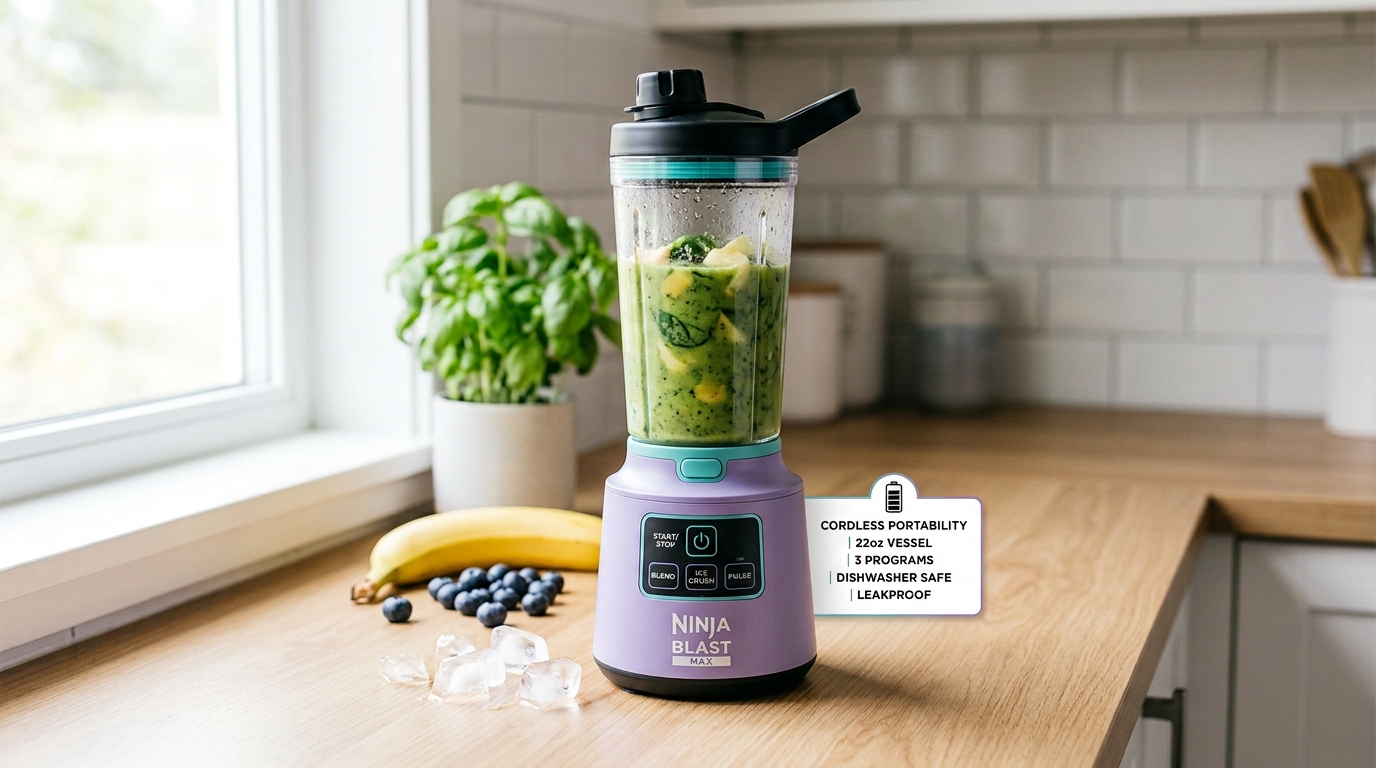
The Ninja Blast Max sits toward the capable end of that range. Cordless operation with three preset programs, a 22-ounce vessel that serves as both the blending container and the drinking cup, ice crushing capability that most basic portable blenders lack, a leakproof design for carrying, and dishwasher-safe construction for simplified cleaning. In lavender and teal, it brings visual personality to a category that has historically defaulted to black and grey.
This article examines what the Ninja Blast Max actually delivers across its intended use cases, how it compares to the broader portable blending landscape, and what’s worth understanding before deciding whether it fits the specific way you’d actually use it.
What Is the Ninja Blast Max?
The Ninja Blast Max is a cordless portable personal blender designed around a 22-ounce vessel that functions as blending container, drinking vessel, and carry cup simultaneously. Unlike countertop blenders that require a separate container, pitcher, or cup for the finished drink, the Blast Max blends and drinks from the same container — and the Twist & Go lid converts that container into a leakproof travel cup for carrying after blending.
The cordless operation — running on a rechargeable battery rather than requiring a power outlet — is the defining characteristic that makes it genuinely portable rather than just compact. It blends on a kitchen counter, at an office desk, at a gym, in a hotel room, in a camper, at a picnic — anywhere accessible, without proximity to an outlet.
Three preset programs — Blend, Ice Crush, and a third program tailored to different blending outcomes — provide more processing intelligence than the single-speed button that defines basic portable blenders. Ninja’s blade technology in a battery-powered format addresses one of the most persistent limitations of early portable blenders: inadequate motor power for processing frozen ingredients consistently.
Key Features of the Ninja Blast Max
Cordless Operation and Battery Performance
The move from plug-in to cordless fundamentally changes where a blender can be used. This is the Blast Max’s most significant capability distinction from countertop personal blenders like the Ninja Fit QB3001SS — both blend into a to-go cup, both use similar blade technology, but the Blast Max does it anywhere a charged device goes.
Battery-powered blenders face an inherent constraint: battery capacity affects both blend power and the number of blending cycles available between charges. The Blast Max’s battery is designed to support multiple blending sessions per charge rather than a single use, though the exact number of cycles between charges depends on what’s being blended — ice-heavy combinations draw more power than softer fruit blends.
Recharging typically uses USB-C, which aligns with the charging infrastructure most households already maintain — the same charger used for phones and laptops works for the Blast Max. This is a practical convenience rather than a technical feature, but it means one less specialized cable to track and one less proprietary charger to worry about.
The cordless design introduces one operational consideration worth understanding: the blender needs to be charged before use. A depleted battery during preparation is a different frustration than a blender that simply works whenever plugged in. Building charging into the routine — putting the Blast Max on the charger when it goes into the bag after use, or designating a specific charging spot — prevents the scenario of reaching for the blender and finding it dead.
Three Preset Programs
The three preset programs — Blend, Ice Crush, and the third Ninja-designated program — represent a meaningful step beyond the single-speed button found on basic portable blenders.
Blend runs the motor through a sequence calibrated for standard smoothie applications — fresh fruit, yogurt, protein powder, leafy greens, and liquid. The sequence manages speed and pulsing patterns to incorporate ingredients and produce smooth consistency from a combination where the materials offer moderate resistance.
Ice Crush applies higher power output in a pattern specifically calibrated for processing ice — the most mechanically demanding task portable blenders attempt. The distinction between a blender that technically runs when ice is present and one with a dedicated ice processing program is significant: without adequate power and appropriate processing patterns, ice either doesn’t get fully crushed, creates inconsistent texture with large chunks alongside finely crushed pieces, or strains the motor in ways that affect performance over time.
The third program covers a different blending scenario — either a more aggressive cycle for denser combinations or a gentler one for more delicate ingredients depending on Ninja’s specific calibration for this model. Understanding the three programs through use reveals which situations each serves best.
The preset system removes the variable of technique from blending outcomes. Rather than holding a button and monitoring consistency by sound and feel — the approach with single-speed portable blenders — selecting the appropriate program and letting it run produces more consistent results regardless of whether the user has developed blending intuition.
22-Ounce Vessel with Twist & Go Lid
Twenty-two ounces is the sweet spot for a portable blending vessel — large enough for a satisfying smoothie serving with room for a meaningful combination of ingredients, manageable enough to fit in a standard cup holder and most bag pockets. The 16-ounce vessels on some competing personal blenders feel limiting for anything beyond a minimal serving; the Blast Max’s 22-ounce capacity produces a full, satisfying drink.
The Twist & Go lid conversion — from blending configuration to drinking configuration through a twist mechanism — is the workflow detail that makes all-in-one portable blenders practically convenient. Blending configuration has the blade assembly sealed to the vessel base (the motor unit). Drinking configuration has the drinking lid sealed to the vessel top. The twist mechanism transitions between these two without requiring removal of contents or transfer to a separate container.
The leakproof seal is the detail that makes the drinking configuration genuinely usable for carrying — throwing the finished Blast Max into a bag or car cupholder without it dripping or opening unintentionally. For a portable blender that’s actually used in the field rather than only at home, leakproof construction is an essential function rather than a bonus feature.
Ice Crushing Capability
Ice processing is where the Blast Max’s Ninja heritage becomes relevant. Basic portable blenders with small motors and no dedicated ice processing program handle ice inconsistently at best — producing chunky results rather than properly crushed ice that integrates smoothly into a blended drink.
The Ninja Blast Max’s Ice Crush program applies appropriate power and processing pattern for ice specifically. This capability matters for anyone who wants blended drinks that are properly cold and properly textured — frozen fruit smoothies, blended iced coffee drinks, crushed ice cocktails — rather than the warmer, less textured result of blending without ice or with ice a basic motor can’t properly process.
For gym use in particular — post-workout protein shakes with ice, blended drinks consumed immediately after exercise — the ice crushing capability produces the properly cold, well-textured result that makes a blended drink refreshing rather than merely functional.
Dishwasher-Safe Construction
The vessel and lid are dishwasher-safe, which addresses one of the most common reasons portable blender habits fade over time — the cleanup friction of daily blending.
Protein powder residue in a blending vessel is notoriously stubborn when it dries. Fruit pulp and berry staining accumulate quickly on unclean surfaces. A blender that requires careful hand washing after every use introduces enough friction that the daily blending habit becomes something done occasionally rather than consistently.
Dishwasher-safe components eliminate that friction — the vessel goes in the dishwasher with the rest of the dishes, comes out clean, and is ready for the next use. The blade assembly typically requires hand washing for safety and performance reasons, but this is a brief task compared to scrubbing the full vessel by hand daily.
Lavender and Teal Colorway
The lavender and teal color combination is a deliberate aesthetic choice in a product category where color has historically been treated as unimportant. Ninja’s decision to offer the Blast Max in this specific palette rather than defaulting to black or silver reflects awareness that portable appliances are visible items — seen on gym bags, office desks, and outdoor tables in ways that countertop appliances stored in kitchens often aren’t.
For users who care about the visual language of their everyday carry items, the lavender and teal combination offers a personality that basic black blenders don’t. This is entirely a personal preference consideration rather than a functional one, but it’s worth noting that Ninja made a deliberate color design choice here rather than treating the aesthetic as irrelevant.
How the Ninja Blast Max Can Be Used
Pre-Workout and Post-Workout Nutrition
The Blast Max’s cordless operation and ice crushing capability make it genuinely useful in gym contexts where the combination of portability and ice processing defines whether a blended drink is practical or theoretical.
Pre-workout: blend a combination of banana, berries, oats, and liquid in the vessel at home before leaving, carry it in the cup holder, consume it on the way to the gym.
Post-workout: bring the Blast Max to the gym in the bag, add protein powder, frozen fruit or ice, and liquid in the locker room, blend with the Ice Crush program, and consume the shake immediately after training while the nutrients are still fresh and the drink is properly cold.
The combination of fresh blending, immediate consumption, and ice-cold temperature is only achievable with a genuinely portable, cordless blender with ice processing capability. Pre-made protein shakes don’t deliver this combination; neither do countertop blenders that require a kitchen.
Daily Morning Smoothies Without the Counter Blender
For households where the full countertop blender represents more setup and cleanup than the morning routine allows, the Blast Max provides a proportionate alternative for single-serve daily smoothies.
Load the vessel the night before — frozen fruit, spinach, protein powder, measured liquid — store in the refrigerator overnight, blend in the morning, and walk out the door with the drinking lid attached. Total active morning involvement: pressing the blend button and twisting the lid. This workflow is achievable with a countertop personal blender like the Ninja Fit, but the cordless Blast Max can be used away from the kitchen counter entirely — at a bathroom counter, at a desk, in a car — wherever the morning routine happens.
Travel and Hotel Room Blending
Hotel rooms don’t have blenders. Traveling consistently while maintaining fresh blending habits requires either accepting a nutrition gap or bringing equipment. The Ninja Blast Max’s cordless operation and compact form factor make it a realistic travel companion in a way that countertop blenders aren’t.
USB-C charging works with standard travel adapters internationally. The leakproof vessel travels in luggage without spilling. The 22-ounce capacity produces a satisfying serving. For frequent travelers who maintain blending habits at home and want to maintain them on the road, the Blast Max enables continuity that no other category of blending equipment provides as practically.
Office Desk Blending
An increasing number of people who blend daily face the challenge of either blending at home and transporting a made drink (which degrades in flavor and nutrition during the commute) or finding a way to blend at work. The Blast Max’s cordless operation — with USB-C charging from a standard laptop charger or desk USB port — makes desk blending genuinely feasible.
Keep the charged Blast Max at the desk, add ingredients at lunchtime, blend fresh, drink immediately. No outlet required, no kitchen needed. The noise level of blending in an open office is a practical consideration — a brief blend cycle is audible but not prolonged — but in environments with private offices or shared spaces with reasonable noise tolerance, the desk blending application works practically.
Outdoor and Adventure Use
Hiking, camping, beach days, park outings — the Blast Max’s battery operation enables fresh blending in contexts where electricity isn’t available. The leakproof vessel protects against the movement and orientation changes of an outdoor bag. For outdoors enthusiasts who want post-hike recovery drinks or pre-activity nutrition in fresh blended form rather than bars and packaged foods, the Blast Max provides a portable solution that genuinely works outside kitchen environments.
Making Single-Serve Frozen Drinks
The Ice Crush program’s capability extends the Blast Max beyond fruit smoothies into frozen drink territory — crushed ice cocktails, frozen coffee drinks, iced blended beverages that require proper ice processing for the right consistency. For someone who enjoys making their own versions of frozen drinks that coffee shops and bars charge premium prices for, the Blast Max provides the ice processing capability that basic portable blenders don’t deliver.
Who the Ninja Blast Max May Be Suitable For
Active People Who Blend Daily
For individuals with consistent daily blending habits — particularly those who blend around gym sessions or want fresh smoothies as a daily nutrition practice — the Blast Max’s combination of portability, ice capability, and dishwasher-safe cleanup serves that habit more completely than countertop alternatives that require kitchen proximity.
Frequent Travelers
People who travel regularly and want to maintain blending habits away from home have few good alternatives to a cordless portable blender. The Blast Max’s travel-appropriate design — compact, leakproof, USB-C charging — makes it the most practical solution for this specific use case.
Office and Desk Workers
For people who spend most of their day at a desk and want fresh blended nutrition accessible without going home or finding a kitchen, the cordless Blast Max provides that capability directly at the workspace.
College Students
Dorm rooms often lack kitchen access and full appliances. A cordless portable blender with dishwasher-safe parts (or easy hand-washing for dorms without dishwashers) provides fresh blending capability in a space where countertop appliances would be impractical.
People Replacing Basic Portable Blenders
For someone who owns a basic $25 to $40 portable blender and has been frustrated by its inability to handle frozen fruit consistently, process ice, or maintain power through a meaningful blend — upgrading to the Blast Max addresses all three limitations through better motor capability, dedicated ice processing, and the three-program system that manages blending sequences intelligently.
Anyone Who Values Aesthetic in Everyday Carry Items
For people who think about the visual consistency of items they carry and use daily — the water bottle, the gym bag, the notebook — the lavender and teal Blast Max’s deliberate color design makes it a considered choice rather than a default one.
Important Things to Consider
Battery Management Is an Ongoing Responsibility
Cordless operation introduces a maintenance dimension that plug-in blenders don’t have. The Blast Max needs to be charged regularly to be available when needed. For someone who will use it daily, building charging into the daily routine — on the charger overnight, charged and ready each morning — manages this without friction. For someone with irregular use patterns, arriving at the blender when it’s depleted is a more realistic scenario.
Battery performance also degrades gradually over years of charging cycles — this is true of all lithium batteries, not specific to the Blast Max. Over a long ownership period, available blend cycles between charges may decrease from the original specification. This doesn’t typically affect individual blend quality, but it does affect how long the device lasts on a charge.
22 Ounces Serves One
The 22-ounce vessel is a single-serving container. For households where two or more people want blended drinks simultaneously, the Blast Max blends one serving at a time. This makes it ideal for individual use and impractical for batch blending. For households that consistently want to blend for more than one person, a full-size countertop blender remains more practical for that specific need.
Blend Quality Has Limits Compared to Countertop Machines
Battery-powered blenders operate within power constraints that countertop machines don’t face. The Blast Max performs well for its category — fresh fruit, yogurt, protein powder, moderate frozen content, standard ice — but it doesn’t match the absolute processing power of a 1,200-watt or 1,500-watt countertop blender for the most demanding applications. Very dense combinations, large quantities of frozen ingredients, or extended blending sessions are better suited to countertop machines with continuous power supply.
Understanding the Blast Max as the right tool for everyday portable blending rather than as a full countertop replacement sets appropriate expectations.
Cleaning the Blade Assembly Requires Hand Washing
While the vessel and lid are dishwasher-safe, the blade assembly that attaches to the motor unit benefits from hand washing rather than dishwasher cleaning. The blades are sharp and cleaning them carefully — using a brush rather than reaching in with fingers — is the safe approach. This is a brief but non-negotiable step in the cleaning routine.
How the Ninja Blast Max Compares to Other Options
Blast Max vs. Ninja Fit QB3001SS
The Ninja Fit is the most direct Ninja-internal comparison — also a single-serve blender with to-go cups, also with two 16-ounce cups, but plug-in rather than cordless. The Fit requires an outlet, which limits it to kitchen and desktop use near power. The Blast Max’s cordless operation enables use anywhere. The Fit’s 700-watt plug-in motor provides continuous power that the battery-powered Blast Max can’t fully match for extended heavy use. The choice between them is fundamentally about where blending happens: kitchen-adjacent (Fit is adequate and lower cost) versus genuinely portable (Blast Max is the right tool).
Blast Max vs. Basic Portable Blenders
Entry-level portable blenders at lower price points typically use smaller, less powerful motors, offer single-speed operation rather than preset programs, and often can’t process ice reliably. The Blast Max’s ice crushing capability, three-program system, and Ninja motor technology represent genuine performance improvements over this category that are noticeable in daily blending with frozen ingredients. For someone who has experienced a basic portable blender’s limitations, the Blast Max addresses them specifically.
Blast Max vs. Full-Size Countertop Blenders
Full-size countertop blenders — the Ninja Professional Blender 2.0 and similar machines — offer more power, more capacity, more versatility for demanding blending applications, and no battery limitations. They require a kitchen counter and an outlet. The Blast Max isn’t a replacement for these machines in household cooking contexts; it’s the tool for blending scenarios where those machines can’t go. For households that blend both in the kitchen and on the go, owning both serves different situations rather than one replacing the other.
Blast Max vs. Other Premium Portable Blenders
The portable blender market includes competitors from BlendJet, Nutribullet Go, and others at various price points. The Blast Max’s advantages within this comparison are the three-program system (most competitors offer single-speed), ice crushing capability (many portable blenders explicitly advise against ice), the 22-ounce capacity (larger than many competing vessels), and Ninja’s established blade technology applied to the portable format. The trade-offs are typically price (the Blast Max sits toward the higher end of the portable blender category) and the specific programs’ calibration relative to individual blending needs.
Frequently Asked Questions
How many blends can the Blast Max handle on a single charge?
Blend count per charge depends on what’s being blended — ice-heavy combinations draw more power than soft fruit blends. Ninja provides specific cycle counts in the product documentation, but in practical terms the Blast Max is designed for multiple daily blends between charges rather than a single use per charge. Checking current product specifications for precise cycle count information is recommended.
Can I blend hot liquids in the Blast Max?
The Blast Max is designed for cold and room-temperature ingredients. Hot liquids create steam pressure in sealed containers that creates safety risks. The blender should not be used with hot contents.
How does charging work?
The Blast Max charges via USB-C, which works with standard USB-C chargers used for phones and laptops. Charge time varies but is typically a few hours for a full charge from depleted. USB-C universality means the same charger used for other devices works for the Blast Max without a specialized cable.
Is the vessel interchangeable with other Ninja portable blender accessories?
Compatibility between Ninja portable blender accessories varies by model generation. Checking Ninja’s current compatibility documentation for the BC251PU model specifically confirms which accessories are interchangeable.
What’s the noise level during blending?
The Blast Max produces audible blending noise during operation — comparable to other personal blenders in its category. The blend cycle’s brevity (typically 60 seconds or less for most programs) limits the total noise duration. In shared or noise-sensitive environments, the blending cycle is brief enough to be minimally disruptive in most situations.
Can I put the vessel in the freezer to pre-freeze ingredients?
The vessel is designed for blending and drinking rather than freezer storage. Checking the product documentation for specific guidance on freezer use is recommended before attempting to freeze the vessel, as material compatibility with freezer temperatures varies by product.
How does the leakproof seal work during carrying?
The Twist & Go drinking lid creates a leakproof seal when properly closed. The seal prevents leaking during typical carrying — in a bag, in a cup holder, carried by hand — during normal movement and orientation changes. It’s not designed for submersion or extreme physical conditions beyond typical carrying.
What’s the warranty coverage?
Ninja typically provides a limited warranty on their blender products. Current warranty terms for the BC251PU model are best confirmed through Ninja’s official current documentation or the product listing.
Conclusion
The Ninja Blast Max earns its position at the capable end of the portable blender category through the combination of features that most directly address the limitations of basic portable blenders: cordless operation that truly goes anywhere, three preset programs that produce more consistent results than single-speed alternatives, ice crushing capability that most competing portable blenders can’t reliably claim, a 22-ounce vessel that provides a full serving rather than a minimal one, and leakproof construction that makes carrying practical rather than risky.
Its value is clearest for people whose blending habits extend beyond the kitchen — gym users who want post-workout shakes blended fresh at the source, travelers maintaining nutrition habits away from home, office workers who want desk-accessible fresh smoothies, outdoor enthusiasts who blend in contexts where electricity isn’t available. For these users, the Blast Max isn’t a convenience upgrade from a countertop blender; it’s access to fresh blending in situations where a countertop blender genuinely can’t go.
The battery management responsibility, the single-serving capacity, the performance ceiling compared to countertop machines, and the positioning at the higher end of the portable blender price range are all genuine considerations worth weighing against specific use patterns. Within those honest parameters, the Ninja Blast Max is a well-engineered portable blender that delivers on what it promises — fresh blending, anywhere, with enough intelligence in its programs and enough power in its motor to handle the ingredients that define genuinely useful blending rather than just technically blending.